2 soldi
APL315
The exhibition has ended.
- Dates
- 23 July — 23 August 2026
- Time
- Tue–Sun 12:00–18:00, closed on Mondays
- Venue
- Kyiv City Art Gallery “Lavra”
small space · 7b Lavrska St - Admission
- Please check with the organiser
About the exhibition
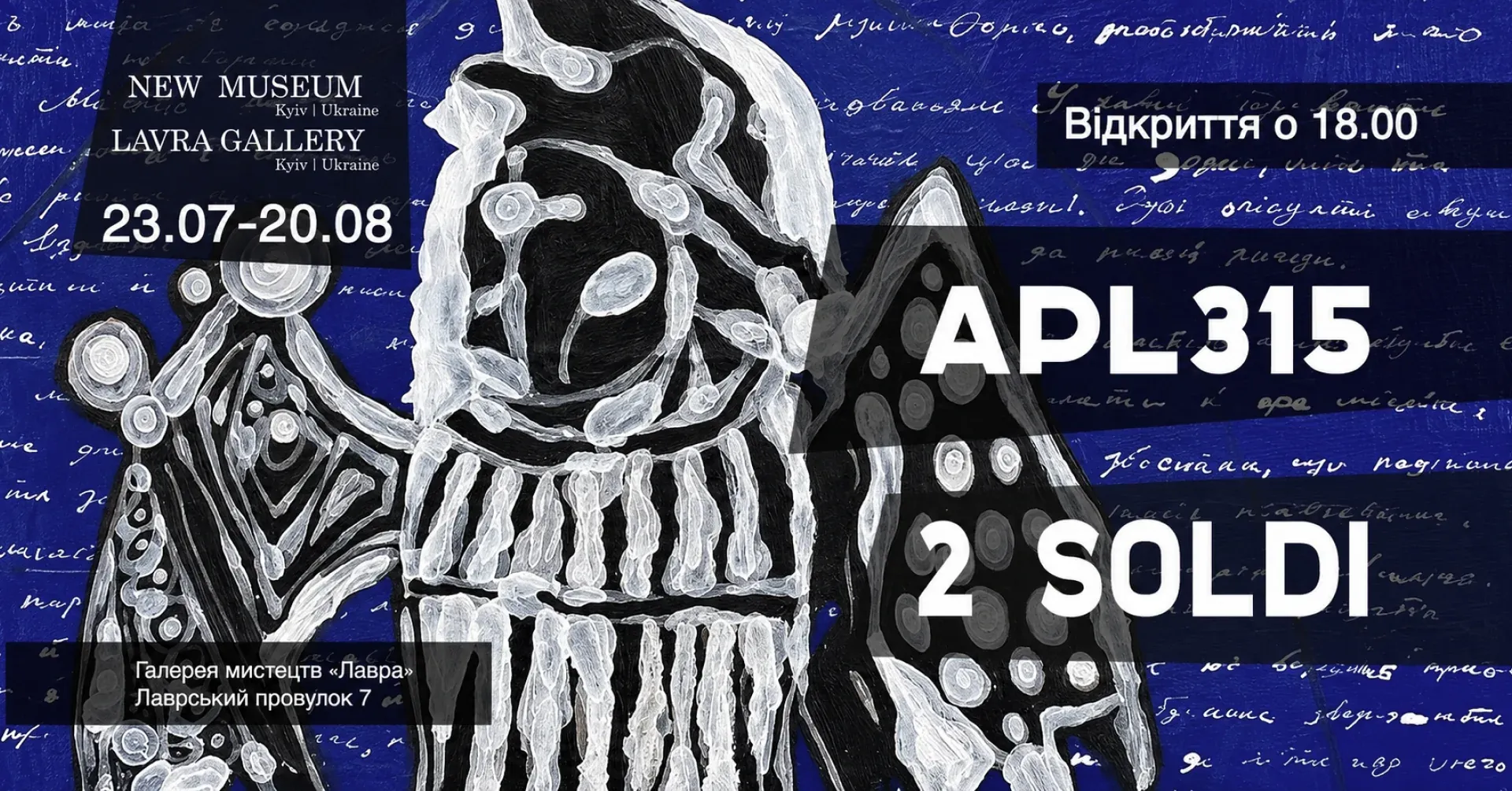
The small exhibition space of Lavra Gallery hosts the opening of “2 soldi”, an art project by the artist APL315.
“2 soldi” is an artistic investigation by APL315 that begins with a small Venetian coin, the 2 soldi, also known as the gazzetta. This modest coin of the Republic of Venice gave its name to the word “gazette” in many European languages: its value was the price of a sheet of news. What matters in this etymology is not only where the word comes from, but how a coin became a measure of access to information — an instrument that set the “exchange rate” of news, language and shared meanings.
This story becomes the artist’s starting point for reflecting on how information acquires value. If in the past news had to be paid for with a coin, today it circulates around us without pause. Information is no longer scarce; on the contrary, its excess creates new forms of pressure. In the stream of messages, facts blend with interpretations, rumours, disinformation, propaganda and the endless repetition of the same events.
All the works in the project were created during Russia’s full-scale war against Ukraine. Yet they are not direct illustrations of specific events; rather, they capture the state of constant informational tension in which people live today. Here news stops being a single message and turns into an unstable, intrusive and exhausting environment.
The second key line of the project is the Piedmontese language. It existed long before modern Italy, belongs to the Western Romance group and differs markedly from literary Italian. Despite the unification of the country and the long standardisation of the language, Piedmontese has survived as part of local culture, collective memory and regional identity. It is also significant that in the 19th century Piedmont became one of the centres of Italian unification while keeping its own language.
Newspapers and language work with memory in different ways. A newspaper lives for a day; a language lives for centuries. News quickly goes stale, while words go on existing even as states, borders and political regimes change. In this sense, language proves a more durable carrier of experience than the daily chronicle of events. The Piedmontese sayings that appear in APL315’s works sound like fragments of another historical memory, yet they unexpectedly resonate with the present. La guera a scava — “war digs” — can be read both literally and metaphorically: war digs up the earth, graves, trenches, the past. Bogia nen — “don’t move”, “don’t retreat” — becomes not just a phrase but a stance. Duri i banchi! — “hold on tight” — keeps the memory of the body bracing before impact. These sayings never translate completely; what matters is not so much their meaning as the very temperature of speech.